How much is Urban Green worth?
The BENEFITS module in GreenSpaces is a scientific tool for calculating and visualizing the key ecosystem services provided by urban trees and shrubs. It uses direct measurement data, meteorological inputs, and species-specific algorithms to quantify benefits such as CO₂ sequestration, particulate matter removal, cooling by transpiration, water interception, and economic value of the benefits generated by each individual plant and aggregate green area.
In summary, the BENEFITS module in GreenSpaces delivers scientifically robust, location-specific ecosystem service assessments by leveraging advanced data integration, field-research-based algorithms, and dynamic weather information, driving both operational decisions and public outreach for urban green asset management.

Ecosystem Service Calculation
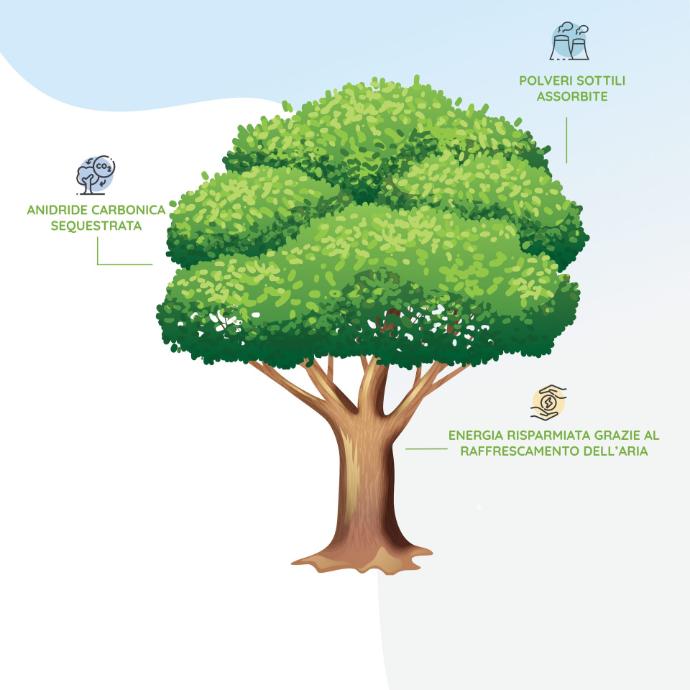
The module determines daily and annual values for CO₂ assimilation, CO₂ sequestration and storage, O₂ production, PM10 and PM2.5 removal, water intercepted by the tree and energy saved through air cooling, based on physiological and biometric parameters.

Weather Data Integration
It incorporates hourly and daily weather forecasts and historical reanalysis (from DWD and ECMWF ERA5-Land), crucial for estimating dynamic ecosystem services that depend on local climate, such as photosynthetic uptake and transpiration.

Tree Inventory Linkage
Calculations are performed for each tree or shrub recorded in the georeferenced GreenSpaces inventory, using species, age, location, and site conditions to select appropriate models and coefficients.

Public Visualization
Results can be shown in real time through dashboards and public portals (optional GREENCITY Module), supporting citizen engagement and urban planning decisions.
Useful Reports
Analysis and Reports: GreenSpaces users can query the ecosystem services for single or multiple trees, generate site-wide summaries, and export reports on annual or daily values.
Decision Support: The module aids planners, managers, and citizens in evaluating management practices, species selection, and urban design scenarios, supporting evidence-based greening strategies.
Calculation Methodology
Scientific Process-Based Models
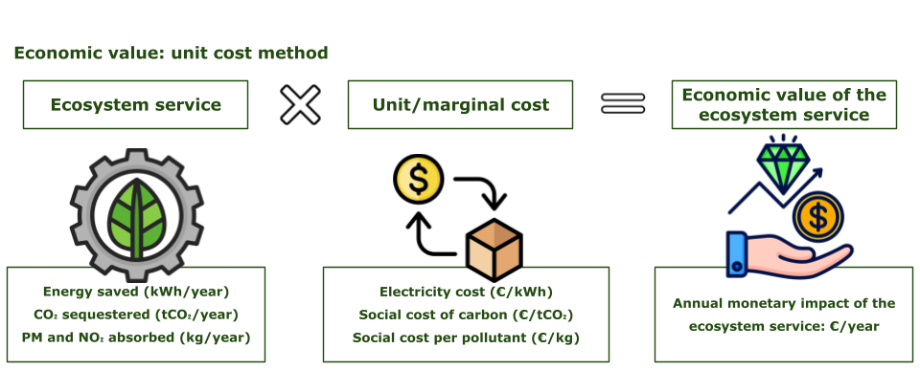
Through research-backed algorithms validated by field measurements (e.g., gas exchange, pollutant deposition, LiDAR measurements), we calculate the tangible benefits provided by tree species, including carbon assimilation, sequestration and storage, urban cooling through latent heat dissipation (transpiration), and the removal of particulate matter (PM10 and PM2.5). We demonstrate how to translate these physical benefits into quantifiable economic value, providing stakeholders with a clear Return on Investment (ROI) for green assets.
The coefficients used in the algorithms are derived from research carried out by the University of Milano, the University of Firenze, ProGea4D and R3GIS in the EU-Funded projects LIFE UrbanGreen and Interreg VerdeVale between 2018 and 2023. For the species not studied in these projects the coefficients were derived from scientific papers or from the database Globallometree.
The methodology has been described in following scientific publications:
Method 1
Uses high-resolution, direct measurement coefficients for species and sites covered by prior field campaigns, ensuring high reliability.
Method 2
For other species, uses interpolated literature coefficients where available, mapped into the GreenSpaces algorithms and updated as new data becomes available.
Method 3
In all other cases, i-Tree and GlobAllomeTree simulations are used for species that have not been directly measured.
Ecossystem Services Assessed

CO2 Cycling

Oxygen Production

Particulate Removal

Cooling Effects

Water Interception

Economic Value
Environmental Value of Green Areas
Our solution provides a powerful way to understand and enhance the environmental value of your green spaces. It automatically calculates key metrics such as average infiltration capacity, which helps assess a site’s ability to absorb rainwater and reduce stormwater runoff; the Simpson Index of tree diversity, which measures resilience of your tree population; and an average tree size index, which quantifies the overall maturity and canopy coverage of your trees. These values are combined to give you a comprehensive environmental score, providing a clear picture of your green space's ecological performance and helping you make informed decisions for its management.
Navigate and Discover some of the Public Portals
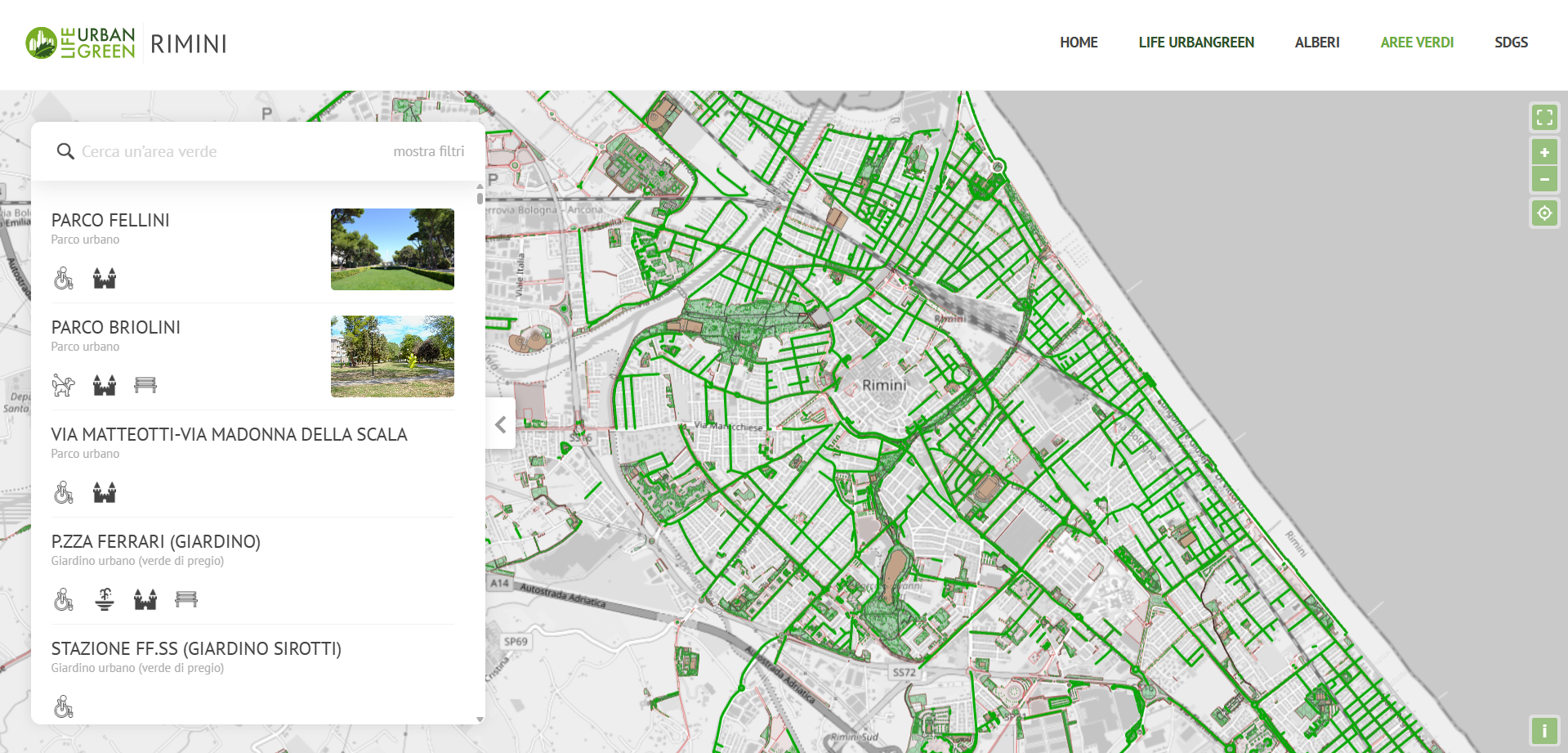
Rimini - Italy
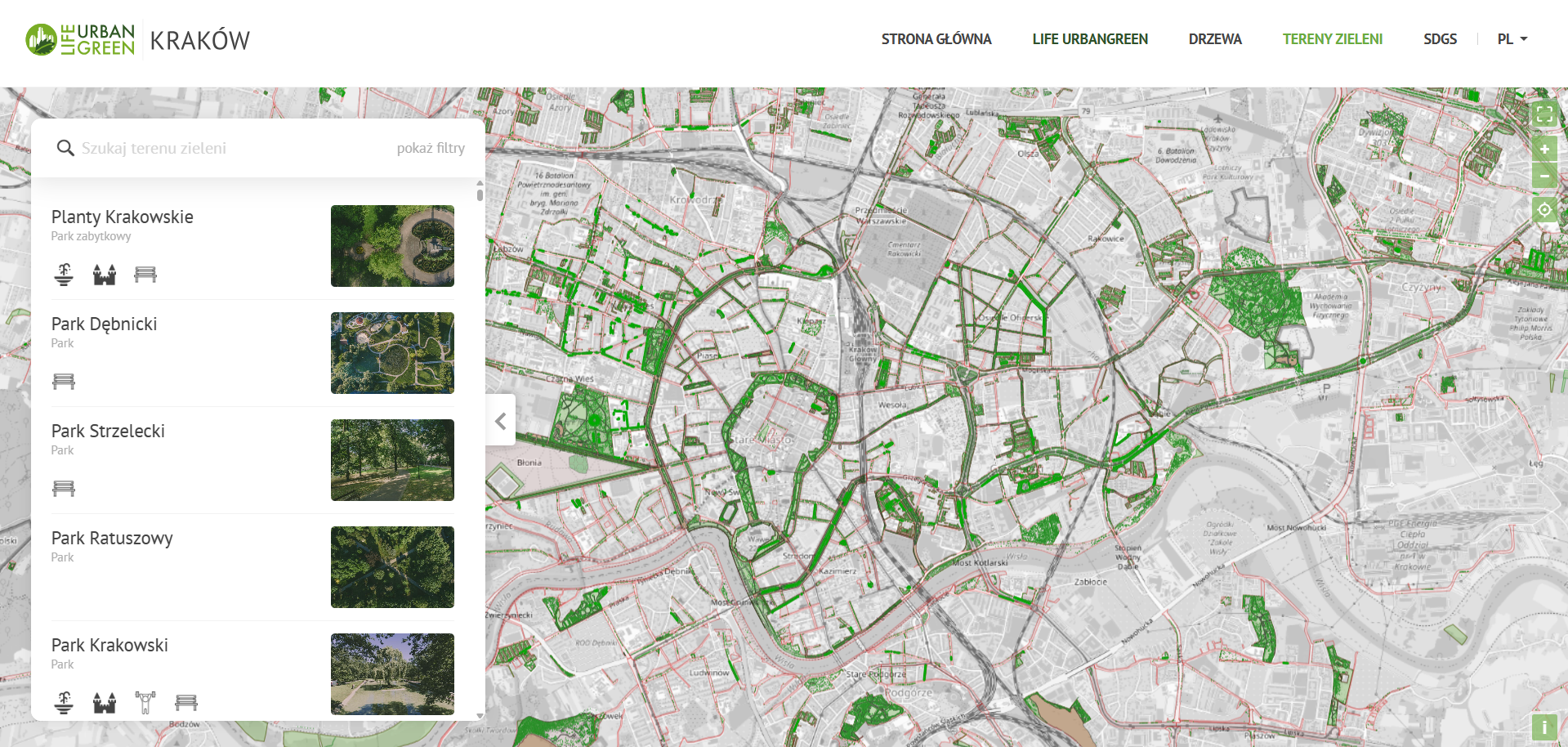
Krakòw - Poland
Data Sources and Reliability
Measurement-Driven: The BENEFITS module prioritizes coefficients from direct measurements (CO₂ exchange, LiDAR biomass, leaf PM depositions), published research, and ongoing field campaigns, especially for key urban species.
Continuous Updates: As new field research expands the database, algorithms update to incorporate more site- and species-specific data, continuously refining accuracy for future calculations.
Contact us to understand how the BENEFITS module can support your city or company to showcase the environmental values
 Thank You!
Scientific References
Fini, A., Vigevani I., Corsini, D., Wężyk, P., Bajorek-Zydroń, K., Failla, O., Cagnolati, E., Mielczarek, L., Comin, S., Gibin, M., Pasquinelli, A., Ferrini, F., Viskanic, P. 2023. CO2-assimilation, sequestration, and storage by urban woody species growing in parks and along streets in two climatic zones, Science of The Total Environment, Volume 903, 166198. https://doi.org/10.1016/j.scitotenv.2023.166198
Vigevani, I., Corsini, D., Mori, J., Pasquinelli, A., Gibin, M., Comin, S., Szwalko, P., Cagnolati, E., Ferrini, F., and Fini, A. (2022). Particulate pollution capture by seventeen woody species growing in parks and along roads in two European cities. Sustainability 14 (3), 1113 https://doi.org/10.3390/su14031113.
Fini, Alessio & Vigevani, I. & Corsini, Denise & Wezyk, Piotr & Cagnolati, E. & Mielczarek, Łukasz & Pasquinelli, A. & Ferrini, Francesco & Viskanic, Paolo. (2025). Effects of management on the provisioning of ecosystem services by mature urban trees. Acta Horticulturae. 43-50. 10.17660/ActaHortic.2025.1429.5.